Recent Posts

Thursday, July 21, 2011

Quick Guide to Smartphone & Mobile SEO

Need to learn more about smartphone and mobile SEO best practices? Let’s start with a few statistics:
According to an infographic from Microsoft Tag, 51% of smartphone users are more likely to buy from a retailer with a mobile specific web site, however: only 4.8% of retailers have a mobile web site.
A recent study by Google, “The Mobile Movement: Understanding Smartphone Users” reports 77% of smartphone users visit search engine websites followed by social networks. And nine out of ten smartphone searches results in an action (purchasing, visiting a business, etc.). Mobile use is growing faster than all of Google’s internal predictions, with YouTube seeing 200 million mobile playbacks a day, according to Eric Schmidt.
To capture the market, marketers and advertisers are increasingly allocating budget to mobile. In fact, eMarketer estimates total mobile advertising spending in the US will reach $1.1 billion this year, which is up 48% over 2010. Mobile search is forecasted to account for up to 10 percent of search budgets with Google capturing 97% of that market.
How can marketers take advantage of the opportunity with mobile search & optimization?
Of course there’s paid search advertising on mobile as there is on the web, but our focus here is on content, social and organic search, so the following tips will emphasize what you can do without advertising.
Fundamental SEO Best Practices – Effective site optimization applies for mobile sites as they would for desktop websites. Search engine accessibility, keywords, content and links all matter with mobile. Keep in mind screen real estate is smaller for keyword use in titles and descriptions. As a primer, check out this post from the Google Webmaster Central Blog, Making Websites More Mobile Friendly.
Mobile Friendly Website – First, decide if you need a dedicated mobile site or if you will present mobile users with a mobile friendly version of your existing site.  If you happen to know that a significant number of your customers use traditional mobile phones, then a dedicated mobile site may be warranted.  See the “Mobile Filters in Google Analytics” tip below for info on determining your website’s mobile activity.
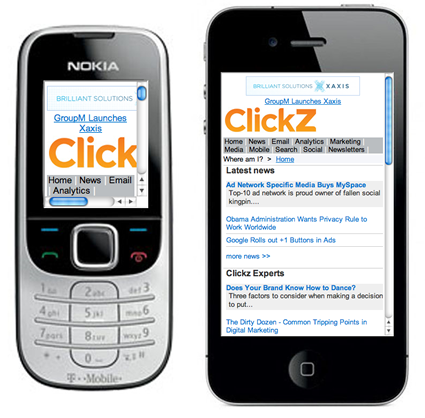
mobile friendly website
A custom CSS file can usually accomplish a mobile friendly site for traditional, internet enabled mobile phones or it may be necessary to develop mobile specific pages.
Smartphones can view most websites as a desktop browser would, only smaller and may not need such customization. Another consideration is that some features, such as Flash content, will not display on an iPhone. Hopefully HTML5 adoption will address that.  While smartphone use is rapidly rising, there are still a very large number of traditional mobile phones in use. A “mobile friendly” site isn’t exactly a SEO tactic, but if people can’t view your site, there’ not much use in it attracting search traffic.
Mobile URLs & Content - Because of advice given by search engines, many Webmasters have their mobile sites detect user agent access via a mobile device and serve up a mobile friendly site using a different URL such as
  • m.mywebsite.com
  • www.mywebsite.com/mobile/
That is no longer necessary and website owners can present the appropriate content using the same URL. rel=canonical can be used for desktop content.  In all instances, the same content must be served to Googlebot and Googlebot-Mobile as what a user would see.  Advantages to a single URL include a single destination for link building and also to facilitate social sharing of pages via mobile phones meant for desktop consumption.
Mobile Keywords – When researching keywords, it’s worth considering that mobile search query strings, on average, are 25 percent shorter than desktop searches. As for mobile keyword research tools, Google’s keyword tool provides a mobile filtering option and the stats you see for Competition, Global and Local Monthly Searches, and Local Search Trends are all specific to the device filter you pick.
Google mobile keyword research
Mobile Formatting and Layout - There are many resources for mobile website development. If you want to test how your mobile friendly website will appear, then Mobile Moxie offers an array of handy tools for testing websites on mobile devices. Tools include: Keyword Research, Mobile HTML Code Grader, Mobile Search Engine Indexing & mSEO, Mobile Website Emulator and Phone Comparison, Mobile Search Engine Simulation and Results Comparison.

Mobile Content – In addition to testing the mobile user experience, it’s also important to test the effectiveness of your mobile content. Delivering mobile search traffic to pages is just the beginning with effective mobile marketing. Make sure the content users are interacting with resonates and inspires desired outcomes. Achieving mobile content effectiveness draws on content marketing best practices by knowing customers, their pain points and interests, keywords and social topics. Then apply that insight to your mobile content strategy. There are numerous mobile marketing case studies to draw ideas from to see what’s worked.
Mobile Site Map – Websites that serve only mobile content can provide Google with an XML sitemap.  Non mobile URLs should not be included, but URLs that return both mobile and non-mobile content can be included.

mobile sitemap
Mobile Filters in Google Analytics - On mobile analytics, Lori Ulloa says, “You can use Google Analytics to track your mobile visitors without creating a separate, filtered profile. You can get info such as those coming from mobile operating systems, mobile devices and even mobile carriers. If you do decide that an app is the right way to go, the Google Analytics for Mobile Apps SDKs make it easy for you to implement Google Analytics in your mobile apps.”
However, if you do want to use filters to extract mobile data (arguably to see if you have a mobile audience in the first place) then Google Analytics offers options in both standard and beta. Filters will inform you how much of your organic traffic is coming from mobile, how they interact with your content and if they’re converting.
Google Analytics Mobile
By 2012 mobile searches will account for 25% of global searches (Google Smartphone User Study). Consumer use of smart phones and tablets has skyrocketed and in keeping with best practices for changing customer information discovery, consumption and sharing needs, mobile marketing warrants serious consideration by companies of all sizes, industries and locations.
You’ve read my take on determining where to allocate search marketing resources before: If it can be searched, it can be optimized. That certainly means mobile search as much as it does search on the web. The question is, how and when your business will approach mobile marketing and more specifically, mobile SEO?


This article was written by Lee Oden. To read more by this author please click here.

Tuesday, July 19, 2011

Success Online is a Journey, Not a Destination

Top 4 Reasons Why SEO Matters When Growing a Business

SEO is now one of the fastest and best developing marketing strategies applicable for any business. As a professional in the marketing industry, I have always believed in the power and potential of SEO now, and in the future. So I've written here four simple reasons why SEO matters when you want to grow your business.

1. SEO increases your website traffic When done properly, you can have your website seen on the first page of search engine results when you type a service or product related to your business. This is not impossible. An experienced SEO team can increase the traffic or visitors of your website, which can spell more customers for your business.

2. SEO helps you build your brand's reputation Representing your brand on the internet is achievable despite having competitors. With your own website, you can market and feature all your products and services. This is also an opportunity for you to connect with possible customers. Be sure to provide useful and informative content your possible customers can read so that they would know you are an expert in your industry.

3. SEO increases profits The more visits you get, then the more chances of converting one of them to a new customer. It is a fact that most people only scan the first page of search engine results and with SEO, you can be on the first page too. This will help increase your earnings.

4. SEO is a cost-effective marketing solution Do not think that SEO services are expensive because there are many companies online that offer affordable SEO solutions for your businesses. Investing on SEO can give you, in return, more quality leads for your business. Any business can benefit greatly with SEO and, in due time, help a business grow. Having a beautifully made website for your business is not enough when nobody will be able to pull it up in major search engines. If you are aiming at growing your business online, then SEO matters.

Any business can benefit greatly with SEO and, in due time, help a business grow. Having a beautifully made website for your business is not enough when nobody will be able to pull it up in major search engines. If you are aiming at growing your business online, then SEO matters.

Thursday, July 14, 2011

9 Marketing Tips from a Six-Year Old’s Lemonade Stand

The other day my daughter, Sophia, announced that she wanted to set up a lemonade stand.
Seeing as how I didn’t really want to spend the better part of my weekend selling lemonade, I tried to talk her out of it by showing her how much she’d need to spend to buy the lemonade mix, get the cups, that sort of thing.
Regardless of my best efforts, there was no changing her mind. She wanted to go into business and there wasn’t anything I was going to do to stop her.
So as I succumbed to my role as venture capitalist in her first business startup. I decided that at the very least, this would be a great chance to teach my daughter about counting money, basic business principals, that sort of thing.

We sat down with a pad of paper and started writing the business plan.
It didn’t take long before Sophia, becoming completely exasperated with my efforts to teach her about price structure and ROI, looked up at me and said:
“But Daddy, I just want to give it away. Our neighbors are so nice, I just want to give them the lemonade.”
Wow! What do you say to that? She hit me with a complete game changer that I didn’t expect.
Suddenly, the lemonade stand had taken on an entirely different meaning.
So we put away the business plan, she drew up a sign and my wife helped her mix a pitcher of lemonade.
Just as we were about to open for business, Sophia came in from the back porch with a sprig of mint she had cut from a pot.
“Can we put mint in the lemonade?” she asked. “I want to make it extra special.”
And with that, on a Sunday afternoon in a quiet neighborhood, she was open for business.
Within a few minutes, one of our neighbors who had heard about the project came over with 50 cents to buy a glass of lemonade. Twice the price my daughter was originally planning to charge.
“But it’s free” Sophia told her.
“That’s OK. I want to pay you for the lemonade”, she replied.
Not knowing what to do with the money, Sophia put it in a cup and set the cup on the table (where everyone could see it).
Before long, more neighbors came by, each one giving her at least 50 cents. When a car would pass, she would jump up and down and scream, “Free lemonade” hoping they would stop.
For the most part they didn’t. However, at one point, one did and the driver handed her three dollars for his glass of lemonade – 1,100 percent more then if she’d gone with her father’s suggestion of 25 cents per cup.
By the end of the day, Sophia had made a whopping eight dollars at her “free” lemonade stand.
When it was all said and done, I realized that although my original business lessons didn’t stick with my daughter, I learned a lot about marketing.
Here are nine lemonade stand tips that you can use to market your services:

1. Give people something for free and they will feel obligated to return the favor

When you help someone, it creates a natural desire to return the favor. As a web designer, provide helpful tips on your blog, participate in forums offering advice and helping non-designers, share ideas on Twitter. In doing so, you’ll not only build trust, but also develop relationships with potential clients.

2. Give potential customers a taste of your offerings

Offer free themes or templates with an easy upgrade to “pro” versions. Provide free stock graphics that hint at potential identity or branding packages while demonstrating your creativity. Just be sure to make it good. When users are excited about the base product, they are much more likely to upgrade.

3. Make it “Extra Special”

Don’t just offer lemonade. Put in that extra sprig of mint. Make everything you do something “extra special” and clients will take notice. Not only will they come back for more, they’ll tell their friends.

4. Don’t Be Afraid to Tell Your “Neighbors” (Network!)

One of the first things my daughter did when she opened her stand was run next door and tell the neighbor. After getting his lemonade, he called two other neighbors to tell them about the lemonade stand – both of whom came right over with “donations”. Don’t be afraid to tell friends and colleagues about your services. You never know, they may talk to your next big client later that day.

5. Do What You Need to Do to Be Seen

It wasn’t enough to just put up a sign. My daughter’s advertising consisted of jumping up and down screaming “free lemonade” at passing cars. While it might seem extreme, it worked. How are you “screaming” about your business?

6. Be Persistent

Even though most of the cars passed by, my daughter didn’t give up. Finally, after many failed attempts, one of them did stop—doubling her income for the day.

7. Build Anticipation

My daughter’s first customer knew about her project and was there as soon as it opened. Don’t just launch your new web site, let people know it’s coming. Drop hints, show them screen shots, make them look forward to the big day.

8. Find Good Partners

My daughter’s little brother kept drinking the lemonade – not the best partner. However, her friend from down the street was out there with her jumping up and down screaming, doubling their advertising efforts.

9. Advertise Your Popularity

Once my daughter’s cup started filling with coins, people were more likely to “donate”. Don’t be afraid to advertise your popularity. Place download counters, comment counts and subscriber numbers in prominent places. Just make sure the stats are high enough to warrant a little bragging.

Written exclusively for WDD by Jim Lodico. He is a freelance commercial copywriter and marketing consultant. You can learn more about his services at his website www.jalcommunications.com

Wednesday, July 13, 2011

Can Your Customers Live Without You??

Is the recession over?  I keep hearing that it is, but I don’t believe it (that’s my issue).  But what matters to our businesses is how our customers feel.  In and out of recession, they still have needs and wants, and if we meet those desires, then we are still in business.
The Product
In “Are Consumers Ready to Start Spending?,” Anita Campbell says, “While it is possible that consumer spending attitudes will loosen up as the recovery strengthens, it’s also possible this may not happen for some time.”  So what’s the small business solution to encouraging customer spending?
Anita gives three suggests to help us do this, including the recommendation that you “position your products and services as good value.”  She explains that value “mean(s) your products or services are high quality and lasting, making them a good value for the money.  With consumers spending less often, they are being more critical and cautious when they do buy and looking for things that are worth spending on.”
Sometimes, it’s easy to hear advice and move past it without applying it effectively.  But take a minute and think about your own spending—especially if you are your target market.  Note your behavior, then pay attention to your clients’ behavior.  What type of product combination does your client need—what type of product combination do you need—to make spending worth it? Now put a strategy in place to create that combination  In your niche, hopefully, your customers feel like they can’t live without you and your targeted solutions.

The Marketing
Keep this in mind, not everyone has been in a recession.  It’s our responsibility to know our clients and adjust accordingly.  But understanding your client base is just the beginning.  You still have to market to them in a way that appeals to that particular group because it’s your marketing that will get them to your doors (off and online).
In the article “Attention Small Businesses: You’re ALL in the Marketing Business,” Ivana Taylor says,  “You’re in business to make money (and, preferably, you keep more than you make).”  In order to make that money, Ivana believes you need to employ an “attractor strategy.”   She adds, “Throwing salespeople out there WITHOUT a marketing strategy and marketing support is what we do when we think we’re in the widget business.”
It’s our job
  • to know our business and our clients
  • to speak a language that connects with our (potential) clients
  • to understand the strategy behind the business, which includes the marketing that keeps us connected to our clients
Put in the time to learn how the marketing piece of your business works. Then establish a system and team to support that strategy.  After all, it’s hard to stay in business when very few know how great you are or that they need and want what you have.  It’s your marketing that lets them know.
The USP
When you finally decide to put on your marketer’s hat (and keep it on), Susan L. Reid, in “5 Steps to Determine Your Unique Selling Point,” has a few tips for you.  Your Unique Selling Point (USP) is the thing that makes you stand out.  Without it, your potential clients cannot understand the difference between you and everyone else who does what you do.  Without it, they can’t understand why they should choose you over anyone else.  Without it, they can’t justify the ongoing spending to themselves nor the others on their team.
Susan urges you to find your USP and:
  • “Stop putting your business at risk.”
  • “Put an end to getting lost in the crowd.”
Plus she gives you five clear ways to get it done.
In the end, your business is about the people you serve, and it’s your marketing that connects you to them.

This article was written by Jamillah Warner of smallbiztrends.com please visit their website to find out about other marketing techniques and tips.

Tuesday, July 12, 2011

5 Marketing Myths

Marketing and sales are frequently confused within businesses, so let’s be clear – marketing is about educating people and raising brand awareness, so when they are ready to buy they have a greater affinity for you compared to a competitor.  Sales focuses on the very act of turning people into customers and while it may take advantage of marketing, it has its own, very well-defined techniques which aim to persuade the one individual to buy.
Perhaps, this is the first myth to be busted – sales is not the same as marketing – but for our purposes, here are our 5 Marketing Myths:

The Lowest Priced Product or Service Wins!

Using low pricing should result in more sales, that’s intuitive and plain common sense!  It may be true in certain instances, especially where your product is viewed by customers as a commodity, i.e. a good which can easily be substituted for another, e.g. gas, sugar, bottled water, orange juice.
Ronson made cigarette lighters in the fifties which initially used a a low-price strategy to compete with Japanese imports.  This was a big mistake – Ronson quality was far superior to anything produced in Japan at that time and with a change in direction, pricing was adjusted to a level far higher.  Sales increased, both in unit volume and dollar revenue with the price rise and this is clearly counter to intuitive logic.  The reason for this was the high cost of the lighters improved the perception of consumers about the quality.  This underlines the reason behind why low-cost pricing increases sales is a myth – it is customer perception which determines whether the product is purchased, and for many, a higher-priced product is equated with a better quality product.

Offer a Broad Range of Products and Services to Win Business
Myth #2 – to effectively market your products you need to be tightly focused on delivering a solution for the customer’s needs.  Building a large product or service range will dilute your marketing efforts, rendering your business less effective when it comes to making actual sales.  Stick to a small, or even single product range to maximize the benefit from your marketing investment.
The Best Advertizing Comes from the Top!
The stereotype image of senior ad executives coming up with a great ad campaign may be the industry image, and reality for many companies.
This is why so much marketing you see is really dire!
The best advertizing comes from your customers and for practical purposes, from your customer-facing sales people.  Find out what your customers are actually looking for – what problems and needs they have and develop your marketing strategy around satisfying those needs.  The best advertizing comes from the bottom and it is the most effective and directly relevant to your customers.
The Best Product or Service is the Most Successful!
If this was true, we all would be reading this using a Mac but, chances are you are reading this online using a PC.  There are plenty of other examples – VHS video tapes beat out the competition from Betamax despite delivering inferior recording and playback quality; Chrysler is now owned by Fiat who make much more inferior cars; Five Guys make a much better burger than McDonalds, and the list goes on.
The product or service which is the most successful is the one which is most effectively marketed and sold.  Specifically, this means aligning your offering to customer needs, desires and aspirations, and doing it better than anyone else.

Increasing Web Traffic is the Best Way to Increase Online Sales!
It sounds right doesn’t it?  Like many marketing myths, it is based on intuition because it seems like common sense.  The truth is that it is easier, cheaper and more immediate to improve your conversion ratios with your existing web traffic to increase sales.  You can do this by improving your online payment process, creating a greater sense of trust and confidence in your product and business, offering price comparison tools on-site and a range of other techniques.
It is easier to sell to existing traffic than it is to sell to someone who has not even visited your store!


This article was written by BS Free Marketing.

Tuesday, July 5, 2011

Are You Committed Enough?

A business is only alive to the extent that there is commitment.
This can be said of the individual elements of any business – the products, the services, the people, the customers, the culture, the story, the brand – but it is the collective attainment of commitment that is the ultimate marker of success.

This quality is elusive, nameless in most businesses, and manifests itself in things like strategy, culture and customer. There is no one thing that activates commitment, no one idea or mission statement, but it is intentional and you can feel it in the people, ideas, processes and stories of a company that has it.

In order to bring something like commitment to life you must first know how to define it, understand how to use it to bring order out of chaos and how to nurture and grow it with every action and interaction.
The thing you must understand about commitment though, is that it cannot be made, it can only be generated, just as a tree cannot be made, it can only come from the careful nurturing of a seed.
I’ll go as far as to suggest the search for this thing I call commitment is the central theme of our lives as well as the one timeless way of creating a business that is fully alive.
Businesses that enjoy commitment most radiate through a collection of definable characteristics that exist both internally and externally. These same characteristics exist in every business to some extent, but it’s the level of intentional manifestation that acts as a potent measure of the degree of commitment one company enjoys over another.
These guiding characteristics come to life as patterns and they define the business through actions taken over and over again by the people that execute strategy, express culture and co-create customer experiences.
So, my first question to you as you contemplate the validity of this idea. Are you committed to what you’re doing? Don’t be afraid to answer – not at all – it may be the best answer. But, if the answer is anything less than “heck yes” – reconsider everything you’re doing


This article was posted by John Jantsch with Duct Tape Marketing

5 Quick Internet Marketing Ideas

  1. Advertise through the search engines and track your results.
  2. Strengthen customer relationships and generate more sales by sending out an email newsletter.
  3. Create great content and tools that will get linked to by other sites.
  4. Create relationships with bloggers and website owners. Give insightful comments on their blog posts and begin conversations on social media sites.
  5. Offer free redistributable downloads with your branding as a viral marketing tool.